Pareto Principle: Focus on 20% for 80% Results in Productivity

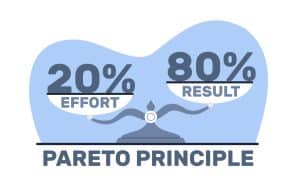
The Pareto Principle, also known as the 80/20 rule, states that roughly 80% of consequences come from 20% of causes, offering a powerful framework for prioritizing tasks and maximizing productivity by focusing on high-impact activities.
In the relentless pursuit of productivity and efficiency, a principle often stands out as a beacon for those seeking to maximize their efforts: The Pareto Principle: Focus on the 20% of Tasks That Yield 80% of Your Results. This powerful concept, often referred to as the 80/20 rule, suggests that a minority of your actions are responsible for the vast majority of your outcomes. Understanding and applying this principle can fundamentally transform how you approach work, personal goals, and even your daily habits, guiding you toward more impactful decisions and a more fulfilling life.
Understanding the Pareto Principle: The 80/20 Rule Explained
The Pareto Principle, often called the 80/20 rule, is a concept that asserts that, for many events, roughly 80% of the effects come from 20% of the causes. This observation was first made by Italian economist Vilfredo Pareto in 1896, who noticed that 80% of the land in Italy was owned by 20% of the population. He later observed similar distributions in other areas, such as 80% of the peas in his garden coming from 20% of the pea pods.
While the exact numbers 80% and 20% are not rigid and can vary, the core idea remains consistent: a significant imbalance exists between inputs and outputs, effort and results. This principle is not a strict mathematical law but rather a general rule of thumb that can be applied across various fields, from business and economics to personal productivity and software development. Recognizing this imbalance is the first step toward strategically reallocating your resources and attention.
Historical context and origin
Vilfredo Pareto’s initial observation about land ownership in Italy laid the groundwork for what would become a universally recognized principle. His work highlighted a fundamental truth about distribution: resources, wealth, and efforts are rarely evenly spread. This insight was later popularized by management consultant Joseph M. Juran, who applied it to quality control, coining the term “Pareto Principle” in the 1940s.
- Vilfredo Pareto’s discovery: Noticed the 80/20 distribution in land ownership and other societal aspects.
- Joseph M. Juran’s contribution: Applied the principle to industrial quality control, identifying the “vital few” causes of defects.
- Widespread applicability: Demonstrated how a small percentage of inputs often leads to a large percentage of outputs.
The principle serves as a powerful reminder that not all efforts are created equal. Some actions inherently carry more weight and produce greater returns than others. By understanding its origins, we can appreciate the depth of its application and its enduring relevance in modern productivity strategies. The Pareto Principle encourages us to move beyond simply working harder and instead focus on working smarter.
In essence, the Pareto Principle challenges the notion that all tasks contribute equally to our goals. It compels us to critically evaluate our activities and identify those that truly move the needle. This foundational understanding is crucial for anyone looking to optimize their time and energy, shifting from a reactive approach to a proactive, results-driven methodology.
Identifying Your Vital 20%: Uncovering High-Impact Tasks
The cornerstone of effectively applying the Pareto Principle lies in the ability to accurately identify your vital 20%. These are the tasks, activities, or efforts that, when given your focused attention, will generate the most significant portion of your desired outcomes. This identification process requires a blend of critical thinking, data analysis, and a clear understanding of your ultimate goals.
Many individuals fall into the trap of treating all tasks with equal importance, leading to busy work that doesn’t necessarily contribute to meaningful progress. To avoid this, you must develop a discerning eye for what truly matters. This involves separating the “trivial many” from the “vital few” in your daily workflow.
Strategies for pinpointing key activities
Identifying your vital 20% isn’t always straightforward, but several strategies can help illuminate the path. Start by clearly defining your objectives. What are you trying to achieve? Once your goals are crystal clear, you can then evaluate each task’s potential contribution to those goals. This often involves a process of elimination and prioritization.
- Goal alignment: Assess how directly each task contributes to your overarching objectives. High-impact tasks are usually those most closely aligned with your primary goals.
- Impact assessment: Consider the potential positive ripple effects of completing a task. Does it unlock other opportunities or significantly advance a project?
- Time vs. reward analysis: Evaluate the effort required versus the potential return. The vital 20% often offers a disproportionately high reward for the effort invested.
- Feedback and data review: Look at past performance. Which activities have historically produced the best results? Data-driven insights can reveal patterns you might otherwise overlook.
For example, in a sales context, 20% of your clients might generate 80% of your revenue. In content creation, 20% of your articles might drive 80% of your traffic. By analyzing these patterns, you can redirect your energy towards nurturing those high-value clients or creating more of the content that resonates most with your audience. This strategic reallocation is where the true power of the Pareto Principle shines.
It’s important to remember that your vital 20% can evolve. As your goals change or your understanding deepens, so too might the tasks that hold the most leverage. Regularly revisiting and re-evaluating your priorities is crucial to maintaining an effective application of the Pareto Principle in your productivity strategy.

Applying the 80/20 Rule to Boost Personal Productivity
Once you’ve identified your vital 20%, the next crucial step is to actively apply this knowledge to your daily and weekly routines. This isn’t just about making a list; it’s about fundamentally shifting your approach to task management, time allocation, and decision-making. The goal is to consciously dedicate the majority of your valuable time and energy to those high-impact activities, while strategically managing or delegating the rest.
Many individuals spend their days reacting to urgent but unimportant tasks, allowing the “trivial many” to dictate their schedule. The Pareto Principle empowers you to break free from this cycle, enabling you to proactively shape your day around what truly matters for your long-term success and well-being. This proactive stance is a hallmark of highly productive individuals.
Practical steps for implementation
Implementing the 80/20 rule effectively requires discipline and a structured approach. It involves a continuous cycle of planning, execution, and review. Here are some practical steps you can take to integrate this principle into your personal productivity framework:
- Daily prioritization: At the start of each day, identify the 1-3 tasks that, if completed, would make the biggest difference. These are your vital 20% for the day. Make sure to tackle these first.
- Time blocking: Allocate dedicated, uninterrupted blocks of time for your high-impact tasks. Protect this time fiercely from distractions and less important demands.
- Delegation and elimination: For tasks that fall outside your vital 20%, consider if they can be delegated to others or eliminated altogether. Not every task needs to be done by you, or even done at all.
- Batching similar tasks: Group similar low-impact tasks (e.g., answering emails, administrative work) and tackle them in a single, focused session to minimize context switching.
Imagine you have a project with ten components. Instead of spending equal time on all ten, identify the two components that will deliver 80% of the project’s value or move it furthest towards completion. Focus your primary efforts there. This isn’t about neglecting the other 80% of tasks entirely, but rather about ensuring your most valuable resources are directed where they will produce the greatest leverage.
The key is to cultivate a mindset that constantly questions the value and impact of each activity. Before starting any task, ask yourself: “Is this one of my vital 20%? Will this task genuinely move me closer to my most important goals?” This simple question can be a powerful filter for your daily decisions, helping you to maintain focus and maximize your output.
Beyond Work: The Pareto Principle in Life and Habits
While often discussed in the context of business and professional productivity, the Pareto Principle extends far beyond the workplace. Its insights can be profoundly applied to various aspects of personal life, from managing relationships and health to developing beneficial habits and achieving personal growth. The underlying premise—that a small percentage of inputs yields a large percentage of outputs—is universal.
Consider your personal well-being. Perhaps 20% of your daily habits contribute to 80% of your overall health and happiness. Identifying these crucial habits and giving them consistent attention can lead to significant improvements across your life, without requiring an overhaul of every single routine. This holistic application allows for sustainable change.
Applying 80/20 to personal growth and relationships
In personal development, the 80/20 rule encourages us to pinpoint the learning activities or self-improvement practices that offer the greatest return on investment. Instead of trying to master every skill, focus on the few that will dramatically enhance your life or career trajectory. Similarly, in relationships, 20% of your interactions or efforts might account for 80% of the strength and satisfaction you derive from them.
- Health and fitness: Identify the 20% of exercises or dietary changes that yield 80% of your health benefits. This might mean prioritizing resistance training and whole foods over marginal gains from obscure supplements.
- Financial management: Pinpoint the 20% of spending categories that consume 80% of your income, allowing you to target effective savings strategies.
- Learning and skill acquisition: Focus on the core 20% of concepts or techniques that provide 80% of the practical utility in a new skill.
- Social connections: Recognize the 20% of relationships that bring 80% of your emotional support and joy, and invest more intentionally in nurturing those bonds.
For instance, if you’re trying to improve your health, instead of obsessing over every calorie or every minute of exercise, you might find that consistently getting 7-8 hours of sleep and eating a balanced breakfast are the 20% of habits that deliver 80% of your overall well-being. By focusing on these foundational elements, you create a robust base for further improvements, rather than spreading your efforts too thinly.
The beauty of applying the Pareto Principle to personal life is its ability to simplify complex challenges. It helps you cut through the noise and identify the leverage points that will create the most significant positive change. This strategic approach fosters a sense of control and reduces the overwhelm often associated with self-improvement, making your journey more effective and enjoyable.
Common Pitfalls and How to Avoid Them
While the Pareto Principle is a powerful tool, its misapplication can lead to frustration or missed opportunities. Understanding common pitfalls and actively working to avoid them is just as important as grasping the principle itself. The 80/20 rule is a guideline, not a rigid law, and its effective use requires nuance and continuous adjustment.
One common mistake is to interpret the 80/20 ratio too literally, expecting it to apply precisely to every situation. Another is to ignore the “trivial many” entirely, which can lead to unforeseen problems or a lack of foundational support for the “vital few.” A balanced perspective is essential for sustainable success.
Navigating challenges in implementation
Successfully integrating the Pareto Principle into your workflow and life means being aware of potential stumbling blocks. It’s not about finding a magic bullet, but rather about developing a more strategic mindset. Here are some challenges you might encounter and how to overcome them:
- Misidentifying the vital 20%: Sometimes, what appears to be a high-impact task might actually be a symptom of a deeper issue. Take time for proper analysis and self-reflection to ensure you’re focusing on true leverage points.
- Neglecting the 80%: While the focus is on the 20%, the remaining 80% of tasks still need to be addressed, albeit with less priority. Develop strategies for efficient handling, delegation, or automation of these tasks rather than ignoring them completely.
- Analysis paralysis: Spending too much time trying to perfectly identify the 20% can lead to inaction. It’s better to make an educated guess and start, refining your focus as you gather more data and experience.
- Static application: The vital 20% can change over time. What was high-impact yesterday might be less so today. Regularly review and adapt your focus to stay aligned with evolving goals and circumstances.
For example, if you’re a content creator, you might identify that 20% of your content topics generate 80% of your engagement. A pitfall would be to *only* create those topics, potentially alienating a segment of your audience or missing out on new trends. Instead, you’d prioritize those high-engagement topics while still occasionally exploring other areas or experimenting. The point is not to eliminate the 80%, but to scale your effort according to impact.
Effective application of the Pareto Principle requires flexibility and a willingness to learn from experience. It’s an iterative process of identifying, prioritizing, executing, and refining. By being mindful of these common pitfalls, you can harness the principle’s power more effectively and avoid common setbacks on your path to greater productivity and impact.
Leveraging Technology for 80/20 Productivity

In today’s digital age, technology offers a myriad of tools and platforms that can significantly enhance your ability to apply the Pareto Principle. From task managers to analytical software, leveraging the right technology can help you identify your vital 20%, streamline your workflow, and protect your focus on high-impact activities. The goal is to use technology as an enabler, not a distraction.
Many individuals find themselves overwhelmed by the sheer volume of digital tools available. The key is to select tools that genuinely support your 80/20 strategy, rather than adding another layer of complexity. Look for solutions that simplify analysis, automate low-value tasks, and help you maintain clear visibility over your priorities.
Tools and techniques for focused work
Modern technology provides powerful means to execute the Pareto Principle with greater precision and efficiency. By strategically choosing and utilizing these tools, you can automate data collection, improve task visibility, and create environments conducive to deep, focused work on your vital 20%.
- Task management software: Tools like Todoist, Asana, or Trello allow you to list all tasks, assign priorities (e.g., using a 1-5 scale or labels for “vital 20%”), set deadlines, and track progress, making it easier to see what truly matters.
- Time tracking applications: Apps such as RescueTime or Toggl automatically monitor how you spend your time, providing invaluable data to identify which activities consume most of your day versus which generate the most results. This data is critical for validating your 80/20 assumptions.
- Analytics dashboards: For business owners or content creators, Google Analytics, CRM dashboards, or sales reporting tools can quickly highlight which products, clients, or content pieces are driving the majority of your revenue or engagement.
- Distraction blockers: Software like Freedom or SelfControl can temporarily block distracting websites and applications, creating a focused environment for tackling your high-impact tasks without interruption.
Consider a project manager using a task management system. By tagging tasks with their estimated impact level, they can quickly filter and identify the 20% of tasks that are critical for project success. They can then use time blocking in their calendar software to dedicate uninterrupted periods to these tasks, while scheduling lower-impact administrative work for later in the day or delegating it to team members. This integrated approach ensures that technology serves as a force multiplier for their productivity.
The strategic use of technology isn’t about doing more; it’s about doing the right things more effectively. By automating the mundane, gaining insights from data, and protecting your focus, technology becomes an invaluable ally in mastering the Pareto Principle and consistently achieving disproportionately high results from your most important efforts.

Cultivating a Pareto Mindset for Continuous Improvement
Adopting the Pareto Principle isn’t a one-time fix; it’s a fundamental shift in mindset that, when cultivated, leads to continuous improvement and sustained high performance. A “Pareto mindset” means constantly questioning, analyzing, and optimizing your efforts to ensure you are always directing your energy towards the highest leverage activities. It’s about moving from a reactive to a proactive and strategic way of thinking.
This mindset encourages a disciplined approach to evaluation, pushing you to look beyond superficial activity and delve into the true drivers of success. It fosters an environment of intentionality, where every decision about where to allocate your time and resources is made with a clear understanding of its potential impact.
Embedding the 80/20 rule into your routine
To truly embed the Pareto Principle into your daily life and work, it needs to become an unconscious filter through which you view tasks and opportunities. This requires consistent practice and a commitment to self-reflection. It’s about building habits that reinforce the 80/20 rule, making it an integral part of your decision-making process.
- Regular review and reflection: Periodically (weekly or monthly), review your accomplishments and efforts. Which 20% of your activities generated 80% of your results? What can you learn from this?
- “Leverage first” approach: Before starting any new project or task, ask yourself: “What is the absolute minimum I can do here to achieve 80% of the desired outcome?” This helps in identifying the core value.
- Embrace strategic inaction: Recognize that doing nothing on certain low-impact tasks is often the most productive choice, freeing up resources for what truly matters.
- Seek feedback on impact: Actively solicit feedback from colleagues, mentors, or clients on where your contributions are most impactful. Their perspective can offer valuable insights into your vital 20%.
For instance, if you manage a team, a Pareto mindset would involve identifying the 20% of team members who contribute 80% of the innovative ideas or project successes, and then investing more heavily in their development and empowerment. It also means identifying the 20% of processes that cause 80% of bottlenecks and focusing improvement efforts there.
Cultivating this mindset helps to prevent burnout by ensuring your efforts are not wasted on low-value activities. It promotes a sense of accomplishment and progress, as you consistently focus on achieving significant results. By making the Pareto Principle a guiding philosophy, you empower yourself to work smarter, live more intentionally, and achieve a disproportionately high return on your invested time and energy.
Measuring Impact and Refining Your 80/20 Strategy

The application of the Pareto Principle is not a static endeavor; it’s an iterative process that requires continuous measurement, analysis, and refinement. To truly maximize its benefits, you must establish clear metrics to track the impact of your focused efforts and be willing to adjust your strategy based on the data you collect. Without measurement, it’s impossible to know if you’re genuinely focusing on your vital 20% or simply making assumptions.
Many people implement a strategy but fail to follow through with rigorous evaluation. This can lead to stagnation or, worse, a misdirection of effort. A robust 80/20 strategy is one that is constantly being tested and optimized, ensuring that your most valuable resources are always aligned with the activities that yield the greatest returns.
Key performance indicators and iterative adjustments
Measuring the impact of your 80/20 strategy involves selecting appropriate Key Performance Indicators (KPIs) that directly reflect your desired outcomes. These KPIs will provide the objective data needed to assess whether your identified vital 20% are indeed producing the expected 80% of results. The insights gained from this measurement then inform subsequent refinements to your approach.
- Define measurable outcomes: Clearly articulate what “80% of results” looks like for your specific goals (e.g., 80% of revenue, 80% of customer satisfaction, 80% of project completion).
- Track effort and results: Use time tracking tools and project management software to monitor the effort invested in specific tasks and the corresponding results achieved.
- A/B testing and experimentation: For certain activities, try focusing on different “20%” candidates and measure which ones yield superior results. This is particularly useful in marketing or product development.
- Regular performance reviews: Schedule dedicated time to review your progress against your KPIs. Analyze what worked, what didn’t, and why, then adjust your focus accordingly.
For example, if you’re a blogger, your KPIs might include website traffic, subscriber growth, or affiliate sales. You might discover that 20% of your blog posts generate 80% of your organic traffic. By measuring this, you can then refine your content strategy to create more of these high-performing posts, or analyze them to understand the common elements contributing to their success. This data-driven approach moves you beyond guesswork.
The iterative nature of refining your 80/20 strategy means that it’s an ongoing journey of learning and adaptation. As circumstances change, new opportunities arise, or existing strategies become less effective, your ability to measure impact and make informed adjustments will be paramount. This continuous feedback loop ensures that your application of the Pareto Principle remains dynamic, relevant, and maximally effective in driving your desired results.
| Key Concept | Brief Description |
|---|---|
| The 80/20 Rule | Roughly 80% of effects come from 20% of causes. A small number of inputs create the majority of outputs. |
| Identifying Vital 20% | The process of pinpointing high-impact tasks that yield disproportionate results through analysis and goal alignment. |
| Strategic Application | Consciously dedicating time and resources to the vital few tasks, while managing or delegating the trivial many. |
| Continuous Refinement | Regularly measuring impact, analyzing results, and adjusting your 80/20 focus based on feedback and evolving goals. |
Frequently asked questions about the Pareto Principle
The Pareto Principle, also known as the 80/20 rule, states that for many outcomes, roughly 80% of results come from 20% of causes. It’s a general observation, not a strict mathematical law, highlighting the unequal distribution of inputs and outputs in various systems.
To identify your vital 20%, clearly define your goals. Then, analyze which tasks contribute most directly and significantly to those goals. Look for activities that have historically yielded the greatest impact or leverage, often requiring critical thinking and data review.
No, the 80/20 ratio is a guideline, not a precise formula. It could be 70/30, 90/10, or another uneven distribution. The core message is that a minority of efforts usually accounts for the majority of results, urging you to seek out those disproportionate relationships.
Don’t ignore the “trivial 80%” entirely. Instead, manage them strategically. Consider delegating, automating, batching similar tasks, or even eliminating those that provide minimal value, freeing up time and energy for your vital 20%.
By focusing on the most impactful tasks, the Pareto Principle helps overcome procrastination by clarifying priorities. It reduces overwhelm by showing that not all tasks are equally important, allowing you to tackle the high-leverage items first and build momentum.
Conclusion
The Pareto Principle stands as a timeless and profoundly effective framework for anyone seeking to amplify their impact and optimize their efforts. By consistently focusing on the 20% of tasks that yield 80% of your results, you move beyond mere busyness to achieve genuine productivity and meaningful progress. This isn’t just about working harder; it’s about working smarter, making deliberate choices about where to invest your most valuable resources—your time and energy. Embracing this principle requires a shift in mindset, a commitment to critical analysis, and a willingness to continuously refine your approach. As you apply the 80/20 rule across your professional and personal life, you’ll discover a powerful pathway to greater efficiency, reduced overwhelm, and a more fulfilling pursuit of your most important goals.