Boost Your Creativity: 7 Techniques to Unlock Your Inner Artist
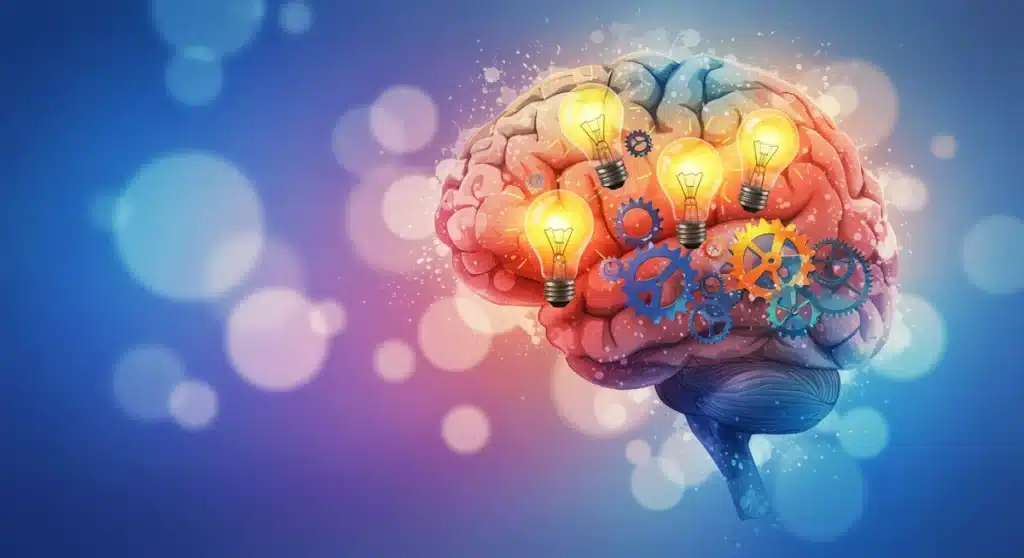
Unlocking your inner artist involves practical application of diverse techniques that challenge conventional thought patterns and stimulate imaginative exploration, ultimately leading to enhanced creative output and personal fulfillment.
Are you feeling stuck in a creative rut, yearning to express yourself more freely, or simply looking for new ways to innovate in your daily life? Learning to boost your creativity: 7 techniques to unlock your inner artist is not just for painters or musicians; it’s a vital skill for problem-solving, personal growth, and professional success. This journey delves into practical methods to awaken your dormant creative spirit.
Embrace playfulness and curiosity
Often, as adults, we lose touch with the natural curiosity and playfulness that fueled our creativity as children. Reconnecting with these fundamental aspects is crucial for breaking down rigid thinking patterns and opening ourselves up to new possibilities. Play isn’t just for kids; it’s a powerful tool for innovation and stress reduction, allowing our minds to wander and make unexpected connections.
Cultivating a sense of wonder can transform how you approach challenges. Ask ‘why’ more often, even about seemingly mundane things. This simple habit can lead to profound insights and novel solutions. Think of curiosity as the fuel for your creative engine, constantly seeking new information and experiences to process and synthesize.
Reignite your childlike wonder
Remember how effortlessly you explored and experimented as a child, without fear of judgment or failure? Try to recapture that uninhibited spirit. Engage in activities purely for the joy of it, without any specific outcome in mind. This could be anything from doodling to building with LEGOs or simply observing the world around you with fresh eyes.
- Experiment without fear of failure.
- Engage in spontaneous, joyful activities.
- Observe your surroundings with fresh perspective.
- Ask ‘what if’ questions frequently.
By consciously setting aside time for playful exploration, you give your brain permission to step outside its usual logical pathways. This freedom allows for serendipitous discoveries and the formation of unique ideas that might otherwise remain hidden. It’s about creating a safe space for your imagination to run wild.
Playfulness also encourages adaptability. When you’re playing, you’re constantly adjusting to new situations and unexpected developments. This flexibility is a cornerstone of creative problem-solving, enabling you to pivot and refine your ideas as new information emerges. Embrace the process, not just the product.
Practice divergent thinking
Divergent thinking is the process of generating multiple unique ideas or solutions to a problem. It’s about quantity over quality in the initial stages, allowing your mind to explore a wide range of possibilities without self-censorship. This technique is fundamental to unlocking your inner artist, as it encourages you to think outside the box and challenge conventional wisdom.
Brainstorming is a classic example of divergent thinking, but there are many other methods to cultivate this skill. The key is to suspend judgment and allow ideas to flow freely, no matter how outlandish they may seem at first. Every idea, even a seemingly bad one, can serve as a stepping stone to something truly innovative.
Techniques for expanding your ideas
One effective method is ‘mind mapping.’ Start with a central idea or problem and branch out with related concepts, keywords, and images. This visual approach helps to connect disparate thoughts and uncover new avenues for exploration. Another technique is ‘SCAMPER,’ an acronym for Substitute, Combine, Adapt, Modify, Put to another use, Eliminate, and Reverse, which prompts you to ask specific questions about an existing idea or product to generate new ones.
- Mind mapping for visual idea generation.
- SCAMPER method for systematic innovation.
- Free association and word games.
- The ‘ten ideas a day’ challenge.
The goal of divergent thinking is to cast a wide net, capturing as many potential ideas as possible before narrowing them down. This broad exploration ensures that you haven’t overlooked any promising solutions. It’s an iterative process that thrives on abundant input, eventually leading to more refined and impactful creative outputs.
Don’t be afraid to embrace the absurd or the impractical during this phase. Often, the most groundbreaking ideas emerge from concepts initially deemed impossible. Allow yourself the freedom to explore all avenues, knowing that you can always refine and filter later. The more ideas you generate, the higher the likelihood of striking gold.
Seek new experiences and perspectives

Our creative wellspring is often replenished by the novelty of new experiences and exposure to diverse perspectives. Stepping outside your comfort zone, whether through travel, learning a new skill, or engaging with different cultures, provides fresh input for your brain to process and synthesize. This constant influx of new information can spark unexpected connections and innovative ideas, directly contributing to your ability to unlock your inner artist.
Routine can be the enemy of creativity. While structure has its place, a rigid adherence to the familiar can stifle imagination. Actively seeking out varied experiences broadens your mental landscape, offering new lenses through which to view problems and opportunities. It’s about feeding your mind with a rich and varied diet of sensory and intellectual stimulation.
Deliberately broaden your horizons
Consider taking a class in an unrelated field, exploring a new genre of music or art, or even just altering your daily commute. These seemingly small changes can disrupt habitual thought patterns and encourage your brain to forge new neural pathways. Engaging in conversations with people from different backgrounds can also provide invaluable insights and challenge your preconceived notions.
- Travel to unfamiliar places.
- Learn a new hobby or skill.
- Read widely across diverse subjects.
- Engage with people from different cultures.
The more varied your experiences, the richer your internal database of associations becomes. This allows for a greater number of potential combinations and permutations when you’re trying to generate new ideas. It’s like having a larger palette of colors to work with when painting; the possibilities for unique creations expand exponentially.
Embracing new perspectives also cultivates empathy, a crucial trait for understanding complex problems and designing solutions that resonate with a wider audience. By seeing the world through different eyes, you gain a deeper appreciation for nuance and complexity, which in turn fuels more sophisticated and impactful creative endeavors. It’s a continuous cycle of learning and growth.
Cultivate a creative environment
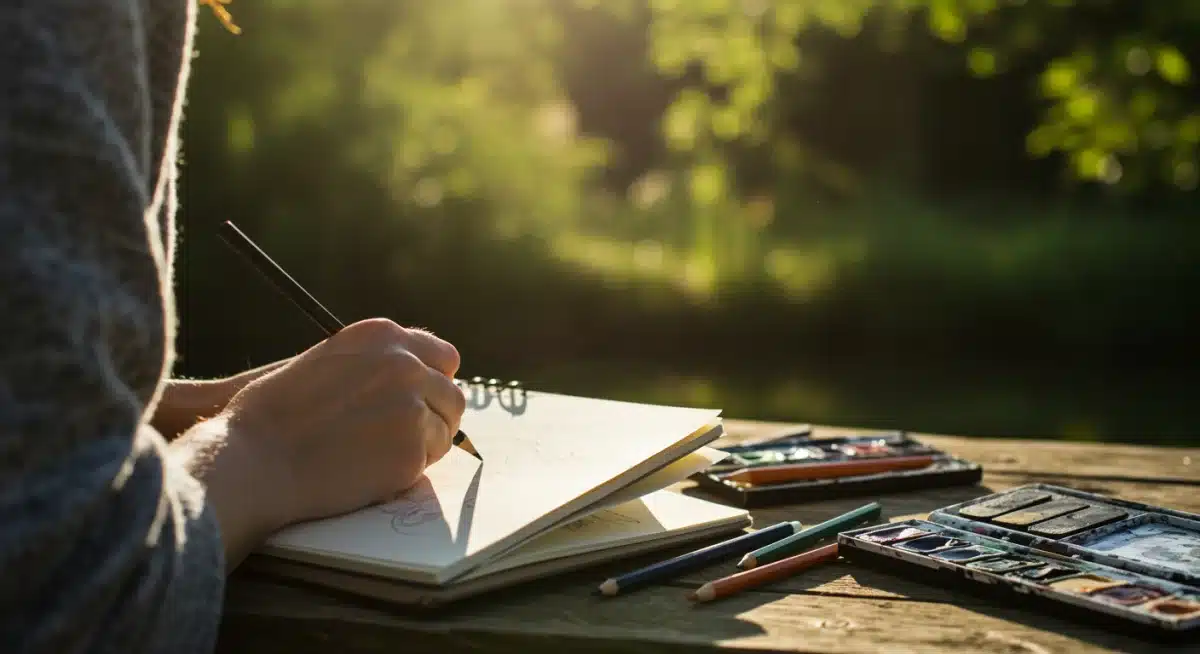
Your physical and mental environment plays a significant role in fostering or hindering your creative flow. A well-designed creative space can be a sanctuary for inspiration, while a cluttered or distracting one can impede progress. Beyond the physical, cultivating a mental environment that supports risk-taking and experimentation is equally important for those looking to unlock their inner artist.
Consider what conditions make you feel most inspired and productive. Is it silence, music, natural light, or a specific type of organized chaos? Tailoring your surroundings to these preferences can significantly enhance your ability to focus and generate ideas. This isn’t about perfection, but about creating a space where your mind feels free to explore.
Optimizing your workspace for inspiration
Eliminate distractions, both digital and physical. Turn off notifications, tidy up your desk, and ensure you have all the tools you need readily accessible. Incorporate elements that inspire you, such as artwork, plants, or objects that hold personal meaning. The goal is to create a space that feels inviting and conducive to deep work and imaginative thought.
- Minimize digital and physical distractions.
- Personalize your space with inspiring elements.
- Ensure good lighting and comfortable seating.
- Keep necessary tools within easy reach.
Beyond the physical space, cultivate a mental environment of psychological safety. Give yourself permission to make mistakes, to experiment, and to produce work that isn’t perfect. Fear of failure is one of the biggest roadblocks to creativity. By embracing imperfection, you free yourself to explore more boldly and authentically.
Surrounding yourself with supportive individuals who encourage your creative pursuits can also be incredibly beneficial. Constructive feedback and shared enthusiasm can fuel your motivation and provide new insights. A positive and encouraging ecosystem, both internal and external, is vital for sustained creative output and for truly allowing your inner artist to flourish.
Practice mindfulness and meditation
In our fast-paced world, the constant barrage of information and demands can make it difficult to access our deeper, more intuitive creative faculties. Mindfulness and meditation offer powerful tools to quiet the mental chatter, enhance focus, and open up channels for creative insight. By grounding yourself in the present moment, you create the mental space necessary to unlock your inner artist.
Mindfulness isn’t about emptying your mind, but about observing your thoughts and feelings without judgment. This practice can help you become more aware of the subtle nudges of inspiration and the patterns of your own creative process. It allows you to step back from overwhelming thoughts and gain clarity, which is essential for problem-solving and idea generation.
Harnessing inner calm for creative breakthroughs

Regular meditation, even for just a few minutes a day, can significantly improve your ability to concentrate and reduce stress. A calmer mind is a more receptive mind, better able to connect disparate ideas and perceive novel solutions. Consider guided meditations specifically designed for creativity or visualization exercises that encourage imaginative exploration.
- Daily mindfulness exercises.
- Meditation to quiet mental noise.
- Creative visualization techniques.
- Journaling to observe thought patterns.
The practice of mindfulness also enhances your observational skills. By paying closer attention to details in your environment and to your internal experiences, you gather more raw material for your creative work. This heightened awareness can lead to a deeper understanding of the world and more nuanced expressions in your art or projects.
Furthermore, an uncluttered mind is better equipped to handle creative blocks. Instead of panicking, a mindful approach allows you to acknowledge the block, understand its nature, and gently explore ways around it. This resilience is a hallmark of a thriving creative practice, ensuring that you can navigate challenges with grace and persistence.
Collaborate and seek feedback
While creativity often feels like a solitary pursuit, collaboration and constructive feedback are vital for refining ideas and pushing boundaries. Engaging with others exposes you to different viewpoints, challenges your assumptions, and can spark new directions you might not have considered on your own. This interaction is a powerful catalyst for anyone striving to unlock their inner artist.
Sharing your work, even in its nascent stages, requires vulnerability but offers immense rewards. Early feedback can help you identify potential weaknesses, celebrate strengths, and gain clarity on how your ideas are perceived by others. It’s an opportunity for growth and a way to ensure your creations resonate with your intended audience.
Leveraging collective intelligence for innovation
Join a creative community, whether online or in person. Participate in workshops, critique groups, or brainstorming sessions. The energy of collective ideation can be electrifying, leading to breakthroughs that individual effort alone might not achieve. Remember, collaboration doesn’t diminish your individual contribution; it amplifies it.
- Join creative communities or groups.
- Seek diverse perspectives on your work.
- Engage in constructive critique sessions.
- Collaborate on shared projects.
When seeking feedback, cultivate an open mind. Not all feedback will be immediately useful, but even critical comments can contain kernels of truth that help you improve. Learn to discern actionable advice from subjective opinions, and always remember that the ultimate vision for your work remains yours.

Collaboration also helps to overcome creative blocks. When you’re stuck, bouncing ideas off someone else can provide the fresh perspective needed to move forward. The back-and-forth exchange of thoughts can illuminate new pathways and inject renewed enthusiasm into your project. It’s a testament to the power of shared human connection in the creative process.
Set creative challenges and constraints
It might seem counterintuitive, but imposing limitations can actually ignite creativity rather than stifle it. When faced with an abundance of choices, it’s easy to become overwhelmed. By setting specific creative challenges and constraints, you force your mind to work within defined parameters, often leading to innovative solutions you wouldn’t have discovered otherwise. This approach is a powerful technique to unlock your inner artist.
Think of it like a puzzle: the boundaries of the puzzle pieces guide you towards a solution. Similarly, creative constraints provide a framework that directs your imaginative energy, making the task less daunting and more focused. This can be particularly effective when you’re experiencing a creative block, as it provides a clear starting point.
How limitations can foster innovation
A constraint could be anything from using only three colors in a painting, writing a short story with a specific word count, or designing a product using only recycled materials. The key is to make the constraint specific enough to be challenging but not so restrictive that it becomes impossible. These self-imposed rules encourage resourcefulness and ingenuit.
- Impose time limits on creative tasks.
- Restrict available materials or tools.
- Work with a specific theme or genre.
- Create within a defined budget.
Constraints force you to think differently, to find novel ways to achieve your goals within the given boundaries. This process often leads to unexpected breakthroughs and a deeper understanding of your own capabilities. It trains your brain to be agile and adaptable, skills that are invaluable in any creative endeavor.
Moreover, completing a creative challenge, even a small one, builds confidence and momentum. Each successful navigation of a constraint reinforces your belief in your creative capacity, making future challenges less intimidating. It’s a continuous loop of learning, problem-solving, and self-discovery that strengthens your inner artist with every iteration.
Prioritize rest and reflection
In our always-on culture, it’s easy to fall into the trap of believing that constant work leads to constant creativity. However, one of the most overlooked yet critical techniques to unlock your inner artist is prioritizing adequate rest and dedicated time for reflection. Our brains need downtime to process information, consolidate memories, and make unconscious connections that often lead to groundbreaking insights.
Sleep, in particular, is not merely a period of inactivity but a highly active state for the brain, crucial for problem-solving and creative thinking. Depriving yourself of sleep can severely impair your cognitive functions, including your ability to generate novel ideas. Similarly, taking breaks throughout the day allows your mind to reset and approach tasks with renewed vigor.
The power of downtime for creative breakthroughs

Beyond physical rest, intentional reflection is equally important. This could involve journaling about your thoughts and ideas, going for a walk in nature, or simply sitting in quiet contemplation. These moments of introspection allow you to gain perspective, identify patterns, and connect seemingly unrelated pieces of information, often leading to ‘aha!’ moments.
- Ensure adequate sleep each night.
- Take regular breaks throughout the day.
- Engage in journaling or free writing.
- Schedule time for quiet reflection.
The concept of ‘incubation’ is central here. Often, when you step away from a problem, your subconscious mind continues to work on it, processing information in ways your conscious mind cannot. When you return to the task after a period of rest or reflection, you might find that a solution or a new creative direction has emerged effortlessly.
Treating rest and reflection as non-negotiable parts of your creative process is an act of self-care that directly fuels your artistic output. It’s about understanding that creativity isn’t solely about working harder, but about working smarter and allowing your brain the necessary space to thrive. Embrace these periods of downtime as essential components of your journey to unlock your inner artist.
| Key Technique | Brief Description |
|---|---|
| Embrace Playfulness | Reconnect with childlike curiosity and experimentation to break rigid thought patterns. |
| Divergent Thinking | Generate multiple ideas without judgment to explore a wide range of possibilities. |
| Seek New Experiences | Broaden your perspective through travel, new skills, and diverse interactions. |
| Prioritize Rest | Allow your brain downtime for processing and unconscious creative problem-solving. |
Frequently asked questions about creativity
The most crucial first step is to embrace a mindset of curiosity and playfulness. This involves letting go of self-judgment and allowing your mind to explore ideas without immediate concern for perfection or practicality, much like a child exploring the world.
To overcome creative blocks, try techniques like changing your environment, engaging in divergent thinking exercises, or setting specific constraints for your task. Sometimes, simply stepping away and allowing for incubation can also yield surprising results, letting your subconscious work.
While some individuals may have a natural predisposition, creativity is largely a skill that can be developed and enhanced through consistent practice, exposure to new experiences, and the application of various techniques. It’s a muscle that gets stronger with use.
Seeking new experiences broadens your perspective and provides fresh input for your brain. This diverse information helps your mind make novel connections and generate unique ideas, preventing stagnation and fostering a richer imaginative landscape for your creative work.
Collaboration can significantly enhance individual creativity by exposing you to different viewpoints and challenging your assumptions. It provides constructive feedback and often sparks new directions, leading to more refined and innovative outcomes than working in isolation.
Conclusion
Unlocking your inner artist and boosting your creativity is a dynamic, ongoing process that combines intentional practice with a receptive mindset. By embracing playfulness, practicing divergent thinking, seeking new experiences, cultivating a supportive environment, engaging in mindfulness, collaborating with others, and prioritizing rest and reflection, you equip yourself with a powerful toolkit for innovation. These seven techniques are not merely isolated steps but interconnected pathways to a more vibrant, imaginative, and fulfilling life. Integrating them into your daily routine will not only help you overcome creative hurdles but also foster a deeper connection to your innate ability to create and innovate, enriching both your personal and professional endeavors.